
My Son Didn’t Break My Screen Time Rules. He Beat Them.
I made him coupons. Walk the dog, ten minutes. I forgot to put an expiration date on them, so he saved up two weeks of chores and spent the lot in one sitting.
What Covid, a sleepover, and a stack of unspent coupons taught me about kids and devices.
When Covid hit, the businesses closing was hard. But for me, the thing that mattered most was the schools closing. Everything I know about screen time rules I learned in the four years after that, and most of it I learned by writing bad ones.
My son Aaron was suddenly home twenty-four hours a day, seven days a week. No sports. No practice, no games, no locker room. No friends, and Aaron has a lot of friends. He is the kind of kid who is always out the door, always headed to somebody’s house. All of that stopped at once.
So I did what I thought was the right thing. I bought him a phone and a computer.
I remember feeling like I had solved something. Now he could call his friends. He could see them. He could talk to them at night the way he used to talk to them on the field. He even had his birthday party on the internet that year, which sounded ridiculous when I said it out loud and turned out to be one of the better days of that whole stretch. Kids on a screen, singing, laughing at each other. It worked. At the time, that phone felt like a life saver, and I still think it was.
Here is the part nobody warned me about.
Covid ended. Things went back to normal. School reopened, sports came back, the friends came back.
And he still had the phone. He still had the computer.
The First of My Screen Time Rules
We made a deal. Homework first. Once it was done, he could get on his electronics, Roblox, other games, whatever he and his friends were into that month.
It seemed fair. It seemed like parenting. And for a while I told myself it was working.
I can point to the exact moment I knew it wasn’t.
The Sleepover
Aaron had five friends over for a sleepover. I was in the kitchen making them dinner. Six boys, one table, all of them together in the same room for the first time in who knows how long.
And they sat there playing games. Against each other.
Not talking. Not wrestling around, not arguing about a movie, not doing any of the things I remember doing at a sleepover. Each of them looking down, competing with the kid sitting eighteen inches away.
I said, guys, put the games down and talk to each other.
And they did. They were polite about it. They put the phones down and they talked — right up until I left the room. Then it was straight back to the games.
That one bothered me more than any argument we ever had about screen time rules. Because that wasn’t Aaron being defiant. That was six kids, all doing the same thing, all perfectly comfortable. That’s just what a sleepover looks like now.
The Coupons
So I told Aaron, this has got to stop. New rule: you want time on your devices, you earn it. You do chores.
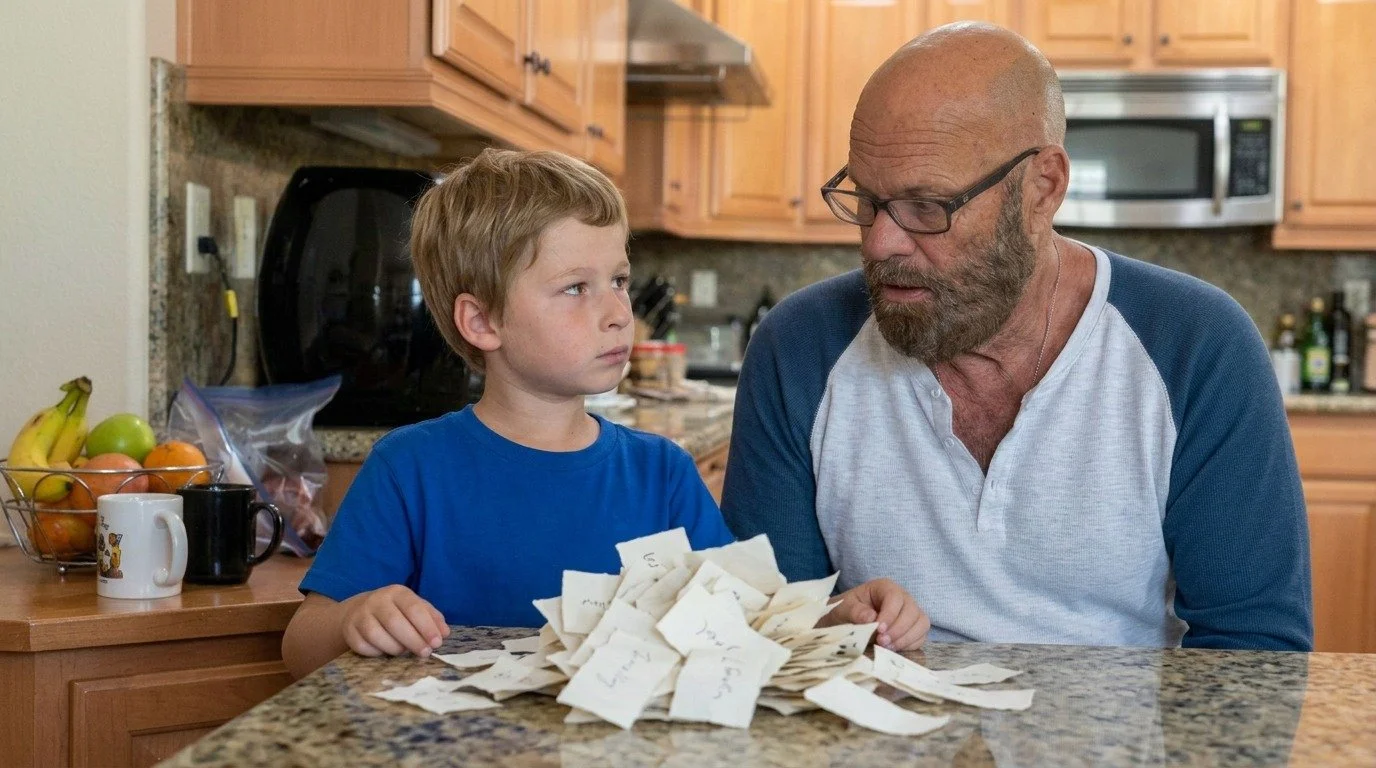
I made him cards. Little coupons, each one worth an amount of time. Walk the dog, ten minutes. That kind of thing. I was proud of this system. It felt like it taught something — work first, reward after.
I made one mistake. I did not put an expiration date on them.
A couple of weeks later I walked in and he was on the phone. I said, Aaron, what are you doing?
He looked up at me, completely calm, and handed me a stack of coupons.
He had been saving them. Every one he earned, he banked. He walked the dog, he did the chores, he took the cards, he put them in a pile — and then he cashed the whole pile in at once.
I stood there holding a fistful of my own coupons trying to figure out whether to be angry.
I wasn’t, in the end. Because he didn’t break the rule. He beat it. He read the system I wrote, found the hole in it, and used it exactly as written. And honestly, a kid who can save up something he wants instead of spending it the second he gets it — that’s not the behavior of a boy who has lost control of himself. That’s the opposite.
The system was the problem. Not him.
What I Watch For Instead of Hours
I spent a long time trying to count minutes, and it told me almost nothing. What I use now are not really rules at all. They are questions I ask myself about once a week.
Is he sleeping?
Does he still have real friends he actually sees?
Can he stop when I ask him to, without a war?
Is it replacing something he used to love? The sports never fully came back after Covid, and I think about that more than I think about Roblox.
Would I be happy following the same rule I just handed him?
A kid can be on a screen a lot and be fine. A kid can be on a screen less and be in trouble. The number of hours tells you almost nothing on its own.
Where My Screen Time Rules Went Wrong
I thought seriously about taking the phone and the computer and throwing both of them in the trash. Some nights I still think about it. I haven’t, and I don’t think I will, and here is why.
The coupons made it worse, not better. When I turned screen time into a currency he had to earn, I taught him it was valuable enough to hoard. I took something ordinary and made it precious. If you make a thing scarce, you raise its price. I did that to myself.
Rules aimed at him didn’t work. Rules aimed at all of us do better. No phones at the dinner table, including mine. Devices out of the bedroom at night, including mine. That isn’t a punishment he has to serve, it’s just how our house works. It is a lot harder for him to argue with a rule I’m also following, and a lot harder for me to enforce one I’m not. It turns out the American Academy of Pediatrics lands in roughly the same place: device-free zones, rules that cover the adults, less counting.
The sleepover wasn’t a discipline problem. I want to be careful here, because this is the thing I got wrong for the longest time. Those six boys weren’t misbehaving. That’s how their friendships are built now. The games are the hangout. I can be sad about that, and I am, some, but no chore chart was ever going to fix it, because there was nothing there to fix. There was just something to understand.
Where I Am Now
I don’t have this solved. I want to be clear about that, because I’ve read enough parenting advice written by people who claim they’ve cracked it, and I never believe them.
What I have is a kid I like, who is smart enough to outmaneuver me, who lost two years of his childhood to something none of us chose. The phone I bought him got him through that. The same phone is the thing I’m now trying to keep in its place.
Both of those are true. I’m still working on better screen time rules, and on being the kind of father who follows them.
If you’ve found something that works, I’d like to hear it.
FAQ
At what age should I start setting screen time rules?
Earlier than you think, and lighter than you think. The habits get set long before the arguments start. What I would tell my younger self is to write the rule for the whole house on day one, rather than inventing one for the kid the week it becomes a problem.
My kid found a loophole. Should I be worried?
Probably the opposite. A kid who reads your rule closely enough to find the hole in it is paying attention and planning ahead. Fix the rule. That is on you, not on him. I have the coupons to prove it.
How many hours a day is too many?
There is no number, and anyone who gives you one is guessing. The screen time rules that actually helped me ignore the clock entirely. Look at sleep, friendships, whether he can stop when you ask, and whether it has crowded out something he used to love. Those four tell you more than a stopwatch ever did.
Do screen time rules have to apply to me too?
In my house, yes, and it was the single change that made the most difference. A rule I follow is one he cannot argue with, and one I actually enforce. It is also the part I find hardest, which I have said out loud on the show more than once.
Should I just take the phone away?
You can, and it works for as long as you can keep it up. But ask what the phone is doing for him first. In 2020 it was the only way my son saw his friends. Take it away without answering that question and the problem does not go away, it moves somewhere you cannot see it. That is true of most screen time rules written in anger.