
My Son Didn’t Break My Screen Time Rules. He Beat Them.
I made him coupons. Walk the dog, ten minutes. I forgot to put an expiration date on them, so he saved up two weeks of chores and spent the lot in one sitting.
What Covid, a sleepover, and a stack of unspent coupons taught me about kids and devices.
When Covid hit, the businesses closing was hard. But for me, the thing that mattered most was the schools closing. Everything I know about screen time rules I learned in the four years after that, and most of it I learned by writing bad ones.
My son Aaron was suddenly home twenty-four hours a day, seven days a week. No sports. No practice, no games, no locker room. No friends, and Aaron has a lot of friends. He is the kind of kid who is always out the door, always headed to somebody’s house. All of that stopped at once.
So I did what I thought was the right thing. I bought him a phone and a computer.
I remember feeling like I had solved something. Now he could call his friends. He could see them. He could talk to them at night the way he used to talk to them on the field. He even had his birthday party on the internet that year, which sounded ridiculous when I said it out loud and turned out to be one of the better days of that whole stretch. Kids on a screen, singing, laughing at each other. It worked. At the time, that phone felt like a life saver, and I still think it was.
Here is the part nobody warned me about.
Covid ended. Things went back to normal. School reopened, sports came back, the friends came back.
And he still had the phone. He still had the computer.
The First of My Screen Time Rules
We made a deal. Homework first. Once it was done, he could get on his electronics, Roblox, other games, whatever he and his friends were into that month.
It seemed fair. It seemed like parenting. And for a while I told myself it was working.
I can point to the exact moment I knew it wasn’t.
The Sleepover
Aaron had five friends over for a sleepover. I was in the kitchen making them dinner. Six boys, one table, all of them together in the same room for the first time in who knows how long.
And they sat there playing games. Against each other.
Not talking. Not wrestling around, not arguing about a movie, not doing any of the things I remember doing at a sleepover. Each of them looking down, competing with the kid sitting eighteen inches away.
I said, guys, put the games down and talk to each other.
And they did. They were polite about it. They put the phones down and they talked — right up until I left the room. Then it was straight back to the games.
That one bothered me more than any argument we ever had about screen time rules. Because that wasn’t Aaron being defiant. That was six kids, all doing the same thing, all perfectly comfortable. That’s just what a sleepover looks like now.
The Coupons
So I told Aaron, this has got to stop. New rule: you want time on your devices, you earn it. You do chores.
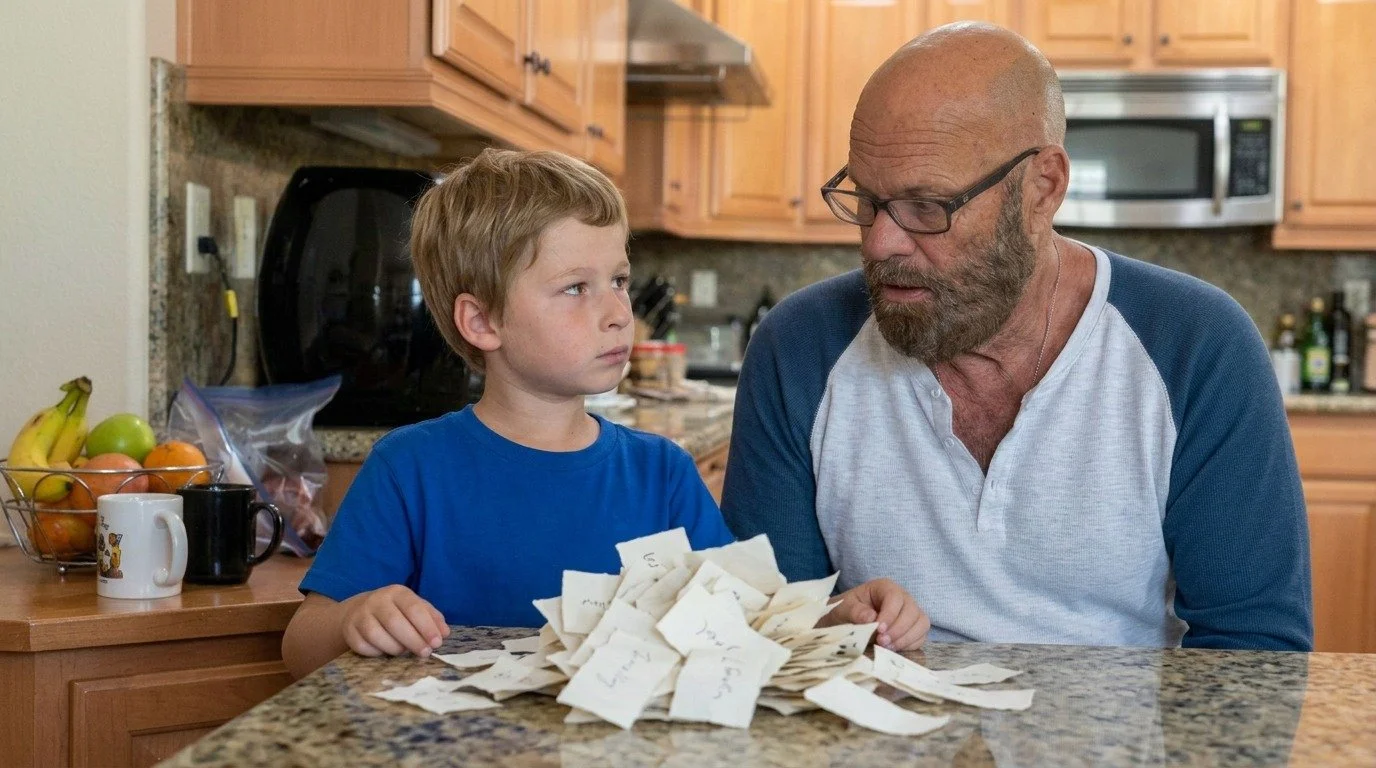
I made him cards. Little coupons, each one worth an amount of time. Walk the dog, ten minutes. That kind of thing. I was proud of this system. It felt like it taught something — work first, reward after.
I made one mistake. I did not put an expiration date on them.
A couple of weeks later I walked in and he was on the phone. I said, Aaron, what are you doing?
He looked up at me, completely calm, and handed me a stack of coupons.
He had been saving them. Every one he earned, he banked. He walked the dog, he did the chores, he took the cards, he put them in a pile — and then he cashed the whole pile in at once.
I stood there holding a fistful of my own coupons trying to figure out whether to be angry.
I wasn’t, in the end. Because he didn’t break the rule. He beat it. He read the system I wrote, found the hole in it, and used it exactly as written. And honestly, a kid who can save up something he wants instead of spending it the second he gets it — that’s not the behavior of a boy who has lost control of himself. That’s the opposite.
The system was the problem. Not him.
What I Watch For Instead of Hours
I spent a long time trying to count minutes, and it told me almost nothing. What I use now are not really rules at all. They are questions I ask myself about once a week.
Is he sleeping?
Does he still have real friends he actually sees?
Can he stop when I ask him to, without a war?
Is it replacing something he used to love? The sports never fully came back after Covid, and I think about that more than I think about Roblox.
Would I be happy following the same rule I just handed him?
A kid can be on a screen a lot and be fine. A kid can be on a screen less and be in trouble. The number of hours tells you almost nothing on its own.
Where My Screen Time Rules Went Wrong
I thought seriously about taking the phone and the computer and throwing both of them in the trash. Some nights I still think about it. I haven’t, and I don’t think I will, and here is why.
The coupons made it worse, not better. When I turned screen time into a currency he had to earn, I taught him it was valuable enough to hoard. I took something ordinary and made it precious. If you make a thing scarce, you raise its price. I did that to myself.
Rules aimed at him didn’t work. Rules aimed at all of us do better. No phones at the dinner table, including mine. Devices out of the bedroom at night, including mine. That isn’t a punishment he has to serve, it’s just how our house works. It is a lot harder for him to argue with a rule I’m also following, and a lot harder for me to enforce one I’m not. It turns out the American Academy of Pediatrics lands in roughly the same place: device-free zones, rules that cover the adults, less counting.
The sleepover wasn’t a discipline problem. I want to be careful here, because this is the thing I got wrong for the longest time. Those six boys weren’t misbehaving. That’s how their friendships are built now. The games are the hangout. I can be sad about that, and I am, some, but no chore chart was ever going to fix it, because there was nothing there to fix. There was just something to understand.
Where I Am Now
I don’t have this solved. I want to be clear about that, because I’ve read enough parenting advice written by people who claim they’ve cracked it, and I never believe them.
What I have is a kid I like, who is smart enough to outmaneuver me, who lost two years of his childhood to something none of us chose. The phone I bought him got him through that. The same phone is the thing I’m now trying to keep in its place.
Both of those are true. I’m still working on better screen time rules, and on being the kind of father who follows them.
If you’ve found something that works, I’d like to hear it.
FAQ
At what age should I start setting screen time rules?
Earlier than you think, and lighter than you think. The habits get set long before the arguments start. What I would tell my younger self is to write the rule for the whole house on day one, rather than inventing one for the kid the week it becomes a problem.
My kid found a loophole. Should I be worried?
Probably the opposite. A kid who reads your rule closely enough to find the hole in it is paying attention and planning ahead. Fix the rule. That is on you, not on him. I have the coupons to prove it.
How many hours a day is too many?
There is no number, and anyone who gives you one is guessing. The screen time rules that actually helped me ignore the clock entirely. Look at sleep, friendships, whether he can stop when you ask, and whether it has crowded out something he used to love. Those four tell you more than a stopwatch ever did.
Do screen time rules have to apply to me too?
In my house, yes, and it was the single change that made the most difference. A rule I follow is one he cannot argue with, and one I actually enforce. It is also the part I find hardest, which I have said out loud on the show more than once.
Should I just take the phone away?
You can, and it works for as long as you can keep it up. But ask what the phone is doing for him first. In 2020 it was the only way my son saw his friends. Take it away without answering that question and the problem does not go away, it moves somewhere you cannot see it. That is true of most screen time rules written in anger.
Teaching Kids Self Control When You’re the One Yelling
I promised myself I’d never lose my temper the way my father did. Then I heard my own voice come out of my six-year-old, in my own driveway, in front of a neighbor.
I promised myself as a kid that I’d never lose my temper the way my father did, and my kids have heard me break it.
Nobody hands you a pamphlet on teaching kids self control that opens with Step one: get a handle on your own. That would be the honest version, and honest versions don’t sell. What you actually get is advice aimed at the child. Count to ten. Name the feeling. All fine. None of it covers the moment you’re standing in a grocery store at 5:40 on a Tuesday with a shrieking kid and a cart full of thawing chicken, plus an audience of strangers quietly deciding what kind of father you are.
The Part Where Your Father Comes Out of Your Mouth
Every parent has a version of themselves they planned on being. Mine was calm. Mine had a low, reasonable register he deployed while the toddler flung a bowl of pasta at the wall, and the toddler — struck by all that reasonableness — would simply stop.
That guy has never once shown up. What shows up instead is a sound I recognize from 1958, coming out of my own face, in my own kitchen. I wrote an entire book about raising confident, happy kids, and the yelling is still in me. Nobody warns you that the hardest habit to break is the one you swore off at age seven.
Teaching Kids Self Control Starts With the Loudest Person in the Room
Here’s the thing about a tantrum: it isn’t defiance. It’s a kid with a feeling bigger than their vocabulary. A toddler screaming “I hate you” is not making a statement about you. She’s naming anger for the first time and doing a lousy job of it. Which is fair. I’ve been naming anger for seven decades and I’m still inconsistent.
The uncomfortable part of teaching kids self control is that they pick it up mostly by watching. Researchers at Pitt and Michigan followed 967 families through early adolescence and found that harsh verbal discipline at 13 predicted more depression and more acting out at 14. Parental warmth didn’t cancel it out. I had been quietly banking on warmth as a rebate.
I Am a Natural-Born Yeller
I should just say it. I’m a yeller. Short fuse, big voice, comes standard with the model year.
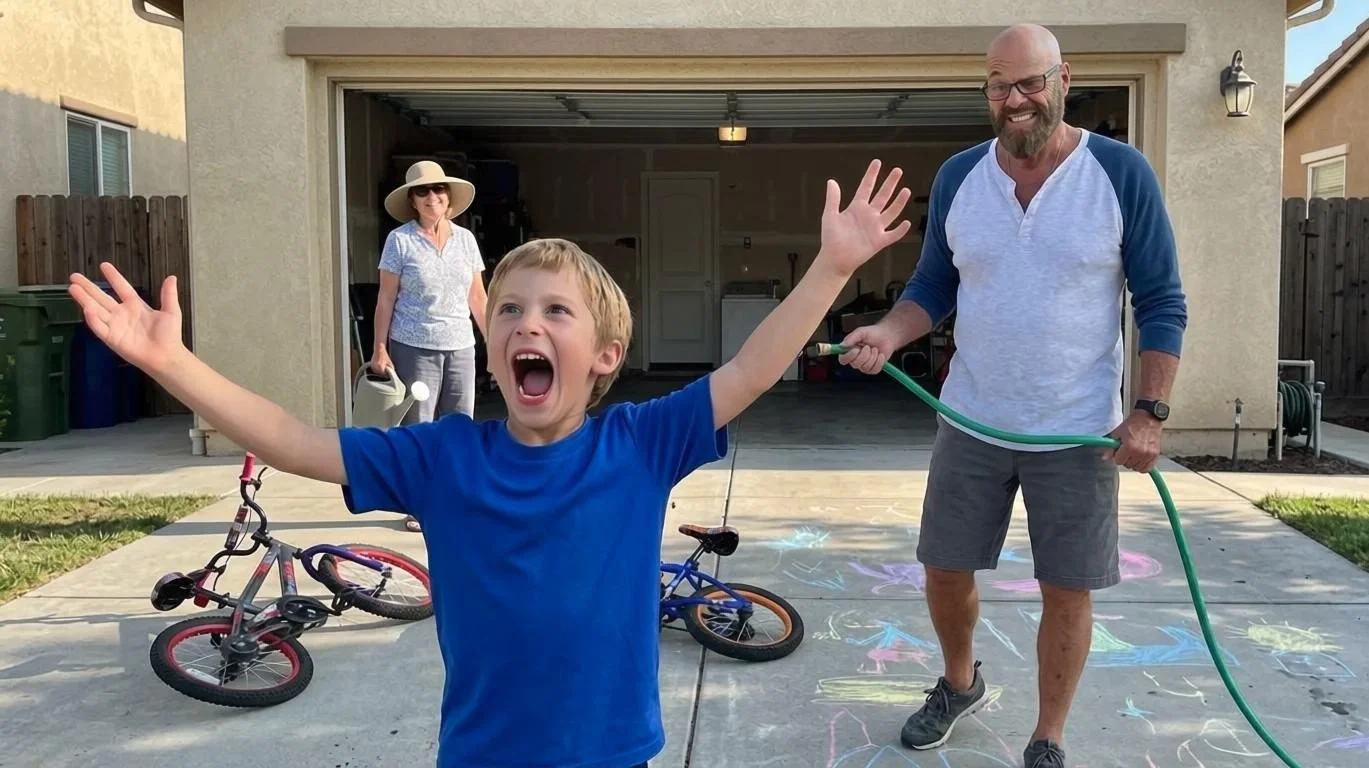
For a long time I told myself it was fine, because I never followed it with anything. No hitting, no belt. Just volume. Then one evening my son got into it with a friend over a toy, and I heard him — the pitch, the cadence, the particular way of leaning in on the last word. It was me. A flawless impression. He had never taken a lesson.
Every book on teaching kids self control will tell you children learn by imitation. What they don’t mention is that the demonstration will be of you, at your worst, performed at full volume in your own driveway, in front of a neighbor. You spend years working on a kid and he hands you a live demo of the one thing you weren’t trying to teach. It had to be nipped in the bud, and nipping it in the bud meant nipping me in the bud, which is a considerably less popular project.
What Teaching Kids Self Control Actually Looks Like on a Tuesday
The whisper works. It sounds like a parenting seminar, and I resented it for years, but if you drop your voice low enough the kid has to quiet down to hear you. You’re not calming him. You’re making him do it himself so he can find out what you said. Take the deep breath where he can see you take it. He’ll steal that too, and this time you’ll want him to.
The rest is unglamorous. Limits you actually hold: “one more story” means one, “two cookies” means two, no matter how good the closing argument is. Choices instead of ultimatums: one game now or two after dinner, pick. I once recorded a whole episode on parenting styles and let my son grade me on mine, a humbling exercise I’d recommend to anyone with a sturdy ego.
And then there’s avoiding temptation, which we dress up as strategy but is really just knowing your kid. Put the good toy away before the playdate. Phones in a drawer at homework time. A kid who isn’t standing in front of the thing doesn’t have to fight it, and neither do you.
Things Nobody Tells You About Teaching Kids Self Control
Your kid will fall down, look straight at you, and decide whether it hurt based on your face.
Red Light, Green Light gets much harder — and much better — the day you flip the rules so green means stop.
The public meltdown is the same as the one at home. The only new variable is you.
“Use your words” is a terrific line that works maybe a third of the time.
You will hold the line on the second cookie and feel like a monster for a solid four minutes.
Most of teaching kids self control happens on ordinary afternoons when nothing is going wrong at all.
The kid isn’t testing you. He’s running an experiment, and he doesn’t know the results either.
The Belt on the Bedroom Door
My father took his belt off slowly. That was the part that got you. The taking off of the belt, the deliberateness of it, while I sat on the edge of my bed like a prisoner awaiting sentencing. I used to envy kids whose fathers wore suspenders. Somewhere in all that waiting I promised myself I’d never do that to my own children.
I kept it. Once, when my daughter was small, I gave her a soft swat on the rear. It didn’t hurt her. She cried anyway, and I understood immediately why. It wasn’t the hand landing. It was the hand going up. Same movie, different dad. I never raised it again, not even as a joke.
So I inherited the fuse and left the belt behind. I’ll take that trade. Teaching kids self control turns out to be less about technique than about deciding, in real time, which pieces of your own father you’re keeping.
Still Loud, Just Less Often
I’d love to close this with a breakthrough. There wasn’t one. I still raise my voice — less often now, and with a shorter recovery time, which at my age counts as progress. There’s an old meditation trick I picked up decades ago: breathe in and smile, breathe out and frown. In with the good air, out with the bad. It is completely ridiculous. I look ridiculous doing it. I have done it in a parked car outside my own house more times than I’d care to put in writing, and it works every single time, which is somehow the most irritating part. Teaching kids self control, it turns out, is mostly a long and undignified apprenticeship in your own.
If you want the longer version of how a guy ends up doing all this again in his sixties, it’s over here.
FAQ
At what age can you actually start teaching self-control?
Earlier than most people think, and slower than most people want. Babies begin learning to self-soothe when they’re confident someone will show up. Toddlers work on naming feelings. Real impulse control keeps developing well into the twenties, so if you’re waiting for it to click, get comfortable.
Is yelling at your kids the same as hitting them?
Not the same, but not harmless either. The Pitt and Michigan study found harsh verbal discipline in early adolescence tracked with outcomes comparable to those other research has found for physical discipline. Raising your voice once at the end of a bad day isn’t that. A pattern of shouting and name-calling is.
My toddler has a meltdown every time we go out. What’s wrong?
Probably nothing. Toddler tantrums are what happens when a big emotion meets a small vocabulary. They’re loud and public, and they’re not evidence about your parenting or your child’s character. The audience is the only thing that changed.
I already lost it and yelled. Do I apologize?
Yes, and keep it short. “I got loud. That was mine, not yours. I’m working on it.” No speech, no bargaining. The apology is worth more than the calm you failed to hold, because it shows him what a person does after they blow it.
Is it too late if my kids are already teenagers?
No, though the job changes. You stop modeling for an audience that copies you outright and start modeling for one that’s watching to see whether you meant any of it. Teenagers are unimpressed by rules and very impressed by consistency. Lower your voice and hold the limits you actually care about.

Gifting an Experience
When toys and Roblox don't cut it anymore, what kind of gift can you give your children (and yourself)? An experience, of course!

If you follow my blog and podcast then you know my 8-yr-old son Aaron is not very interested in any gifts other than Robux, the virtual currency players use in Roblox to acquire all sorts of virtual stuff, like helmets or designer clothing - though I’m sure this feature is not unique to Roblox I’m still suffering sticker shock over a special hairdo and a weird armor-like suit Aaron “bought”, which can’t even be worn in the real world! Having said that, I don’t think most people would want to actually wear it outside their gaming.
But I digress. The bottom line is that Aaron is not interested in the rest of the toys and gifts kids his age normally want, at least not in the same measure - even his ever-favorite Lego had taken a hit, he hardly touched them these days. I’ve been finding myself searching for interesting science kits, outstanding board games or card games, and even almost got him a baby Yoda, though he doesn’t watch The Mandalorian nor has developed the Star Wars itch.
What kind of gift can you get a kid who really doesn’t seem to want anything?
“Why don’t you get him an experience? That’s what’s hot these days, so my son tells me,” my brother Mark suggested.
“An experience? He’s a little bit young for that, don’t you think?”
“Not that kind of experience, Jimmy. Geez! I mean, like a trip or a special playdate with friends.”
“An experience, huh.”
“Yeah, like those places where you go to paint and drink wine,” Mark paused for a second. “That one is only for adults.”
“Glad you clarified that for me.”
I thought about what Mark said. Maybe he was unto something? I thought it was worth a try, so I looked for gift experiences online. A quick search took me to PureWow.com and their article on suggested experiences for kids (here’s the link: https://www.purewow.com/family/experience-gifts-for-kids) Their list covers a wide range of kits and memberships that I found cool and potentially fun. Knowing my kid though I figured learning how to make chocolate truffles or a virtual tour on Amazon.com might not cut it. Besides the Roblox coding course listed in the article - more hours in a digital environment? I don’t think so - I really was unsure of what or if anything would interest Aaron.
I realized it was Aaron who needed to look through this list. I was lying in bed with my laptop open on this website when he ran in.
“Dad, can I have the iPhone?”
“You know you can’t.”
“Ok.”
“Come here. Let me show you something.”
Half-heartedly, he slumped himself next to me.
I explained to him what gifting an experience was and showed him the offerings. I did not tell him the gift was for him, though.
We spent about 45 minutes going through the website’s recommendations, discussing the merits of each. There were theme park adventures, and wood crafting kits. I was trying to measure his level of interest by how long his attention lingered over each entry. I got mostly “meh” and downright disinterest. So far the magic show had held his attention the longest.
“The magic show sounds kinda cool,” I said as casually as possible.
“Yeah”
“I mean, if someone gifted you a magic show it would be fun, right?”
“Meh. Maybe.”
“I could be your assistant…”
Aaron rolled his eyes and laughed.

I woke up a couple of hours later. I could say that this constant napping is an age thing but, alas, it’s a talent I share with my Dad, who could fall asleep anywhere at any time his entire life.
I found Aaron in the living room building a Lego structure, which he hadn’t done in a long time. I sat on the couch, just watching him.
He noticed me and ran over to show me what he had put together.
“Dad?”
“What?”
“Can we look at that list again?”
As we sat side by side looking at the webpage again I realized that searching for the perfect gift experience had become the experience itself.
Life can be so simple sometimes.